
From Circuits to CEOs: Why Engineers Make the Best Founders (And No One Talks About It)
3 min read
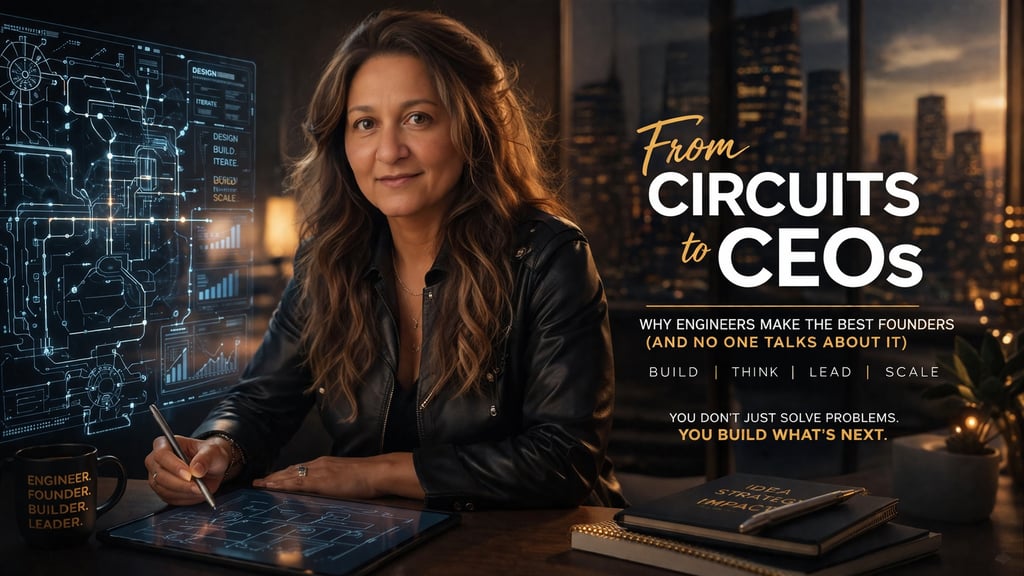
From Circuits to CEOs: Why Engineers Make the Best Founders (And No One Talks About It)
It’s Time to Say It Clearly
The startup world loves loud personalities. Visionaries. Pitch masters. Big talkers.
But many of the strongest companies are built by people who do not lead with noise.
They lead with structure.
Engineers.
They are not just writing code. They are building systems that hold under pressure, adapt under stress, and scale without breaking. That is exactly what a business requires.
The Advantage Most People Miss
Engineers do not approach problems casually. They break them down, map dependencies, and design solutions that can be repeated.
That creates a different type of founder.
One who builds with intention.
Key advantages:
Comfort with complex systems
Discipline in execution
High tolerance for iteration and failure
Bias toward testing instead of guessing
These are not soft advantages. These are operational advantages.
Why Engineers Win in Uncertain Environments
Startups are not stable environments. They shift constantly.
Engineers are trained for this.
They already work in cycles of:
Build
Test
Measure
Refine
That same loop applies directly to business models, marketing channels, and product development.
Instead of reacting emotionally, engineers adjust based on data.
That alone eliminates a large percentage of founder mistakes.
Real Companies Built This Way
Some of the most recognizable companies follow this exact pattern.
Elon Musk — Built multiple companies by applying engineering logic to entire industries
Reed Hastings — Structured Netflix around systems, data, and iteration
Drew Houston — Solved a personal problem and scaled it with precision
These are not exceptions. They are examples of a pattern.
Case Study:
Engineering Applied to Public Health
One of the clearest examples of engineering thinking applied outside traditional tech comes from Biobot Analytics.
Biobot developed a wastewater analysis system that tracks disease spread at the community level. Instead of relying on reported cases, they built a system that detects signals before they surface in traditional data.
That shift changes everything.
It moves decision-making upstream. It gives communities earlier insight. It turns reactive systems into proactive ones.
This is what engineering looks like when applied to real-world problems:
Identify a gap in existing systems
Build a method to capture better data
Create a scalable solution that improves outcomes
Biobot did not just build a tool. They built a system that redefined how public health data can be gathered and used.
That is engineering applied to impact.
This is not theory. It is execution at scale
Biobot Analytics: Transforming Public Health Through Engineering Innovation
Biobot Analytics, founded by engineers from MIT, exemplifies how technical expertise can drive groundbreaking solutions in public health. The company developed technology to analyze wastewater, enabling the monitoring of disease spread within communities. This approach provided a novel method for tracking public health trends, particularly during the COVID-19 pandemic. By leveraging engineering principles, Biobot Analytics created a scalable solution that offered real-time insights into community health, demonstrating the profound impact engineers can have when they apply their skills beyond traditional boundaries. MIT Department of Mechanical Engineering
Source: MIT News
Where Engineer-Founders Get Stuck
Technical strength builds the foundation. It does not complete the structure.
Common gaps:
Communicating value clearly
Leading people with different skill sets
Translating features into outcomes
Making decisions without perfect data
This is where many engineers stall. Not because they lack ability, but because they stay in builder mode too long.
The Shift That Changes Everything
To move forward, the role must change.
From building → to directing
From solving → to deciding
From executing → to leading
Practical moves:
Document processes so others can execute
Focus on clarity, not control
Build systems that include people, not just tools
This is not a personality change. It is a functional shift.
The Real Takeaway
Engineers are not “becoming” founders.
They already think like them.
The difference is whether they step into the role fully.
Checkpoint
Take the next step with intention:
Take the Founder Mindset Quiz
Use the Where’s My Niche? Workbook to define direction
Review an engineer-led startup case study and reverse-engineer the model
Snail Mail
2985 Gordy Pkwy
Marietta, GA 30066
Subscribe to My eNewsletter
© 2026 Jacqueline Gordon-Shim, PhD. Author. Entrepreneur. Engineer. Instigator. All Rights Reserved.
Terms of service